If you work in safety in India or the Gulf region, you’ve probably seen the same question come up over and over again on WhatsApp groups and LinkedIn forums: “What is the real safety officer salary in Saudi Arabia right now?”
The answer in 2026 is very different from what it was just two years ago.
Saudi Arabia is going through a historic change in its labor and industry. Vision 2030, the kingdom’s ambitious plan to move away from oil, is behind megaprojects like NEOM, the Red Sea Project, and Qiddiya, which are costing billions of riyals. With this building boom, there is one thing that must come first: safety at work.
Recent data from GulfTalent and Payscale (2026 updates) show that the need for qualified Safety Officers (also known as HSE Officers) has grown by more than 22% every year. Salaries have been going up quickly because there aren’t enough certified local workers.
For Indian and foreign professionals, this means one thing: now is the best time in five years to ask for a bigger package in KSA.
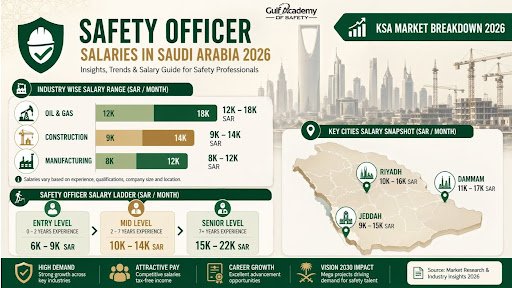
Average Safety Officer Salary in Saudi Arabia 2026 (SAR Ranges)
Before we talk about cities and certifications, let’s set the stage. The numbers below show the monthly base salary in Saudi Riyals (SAR). They do not include housing or transportation allowances.
Data source: GulfTalent, Bayt.com, and 2026 KSA labor market surveys that look at the whole market
| Experience Level | Monthly Salary (SAR) | Monthly Salary (USD approx.) |
|---|---|---|
| Entry Level (0-2 yrs) | SAR 4,500 – 6,000 | $1,200 – $1,600 |
| Mid Level (3-5 yrs) | SAR 7,000 – 10,000 | $1,860 – $2,660 |
| Senior Level (6-10 yrs) | SAR 12,000 – 18,000 | $3,200 – $4,800 |
| HSE Manager (10+ yrs) | SAR 20,000 – 35,000+ | $5,300 – $9,300+ |
Key takeaway: The most important thing to remember is that the lowest salary for an entry-level job is SAR 4,500. However, in 2026, a lot of mid-level jobs will pay more than SAR 10,000, especially for people with international certifications.
Salary by Industry: Who Pays the Most?
1. Oil & Gas (Top Tier)
Employers: Saudi Aramco, SABIC, Halliburton, Schlumberger
- Salary Range: SAR 12,000 – 25,000+
- Why it’s high: High-risk environment (fire, explosion, H2S). Aramco requires stringent third-party auditing (APCS). A NEBOSH Diploma holder here can easily out-earn a construction manager.
2. Renewables (Vision 2030 – Rising Star)
Projects: Al Shuaibah Solar, NEOM Green Hydrogen
- Salary Range: SAR 10,000 – 18,000
- Context: As Vision 2030 calls for 50% of energy to come from renewable sources by 2030, solar and wind farms need HSE officers who know how to work with electricity safely and manage the environment.
3. Construction (High Volume)
Projects: NEOM, ROSHN, Diriyah Gate
- Salary Range: SAR 6,000 – 14,000
- Context: Most jobs, but also the most different ones. Giga-projects pay a lot of money, but small villa compounds don’t.
4. Facilities Management (Steady)
- Salary Range: SAR 5,500 – 9,000
Context: Less pay, less risk. Usually needs OSHA or IOSH, but not often NEBOSH Diploma.
5. Manufacturing & Heavy Industry
Salary Range: SAR 7,000 – 12,000
Context: There is always a need for NEBOSH IGC holders to keep machinery and confined spaces safe.
Verdict: SAR 15,000 or more, focus on oil and gas or big projects. If you want a visa fast, go for Construction.
Salary by Certification: The NEBOSH vs. OSHA Debate
This is the most important part for our readers. Does paying $500 for a NEBOSH IGC really make you more money? Yes. Yes, for sure.
This is a comparison of monthly salaries in 2026 based only on your highest safety certification and 3–5 years of experience.
| Certification Level | Monthly Salary (SAR) | Hiring Demand (KSA) |
|---|---|---|
| No Formal Cert (Only experience) | SAR 1,500 – 2,000 | Low (Local agencies only) |
|
OSHA 30 Hours (US standard) IOSH MS (UK standard) |
SAR 3,000 – 5,000 | Medium (Construction tier 2) |
| NEBOSH International General Certificate (IGC) | SAR 5,000 – 14,000 | Very High (Industry Standard) |
| NEBOSH Diploma (Level 6) | SAR 15,000 – 25,000+ | Critical (Aramco/SABIC) |
The Premium: If you have a NEBOSH IGC, you can expect to make about SAR 2,000 to 6,000 more per month than someone who doesn’t have one. Having a NEBOSH Diploma can often double your base salary right away.
What? Saudi Aramco and SABIC clearly say in their contractor HSE manuals (SABIC SHEM standard) that NEBOSH is a must-have. You can’t go on their sites without it.
Salary by Experience Level (Detailed Breakdown)
0-2 Years (Fresh Graduate / Trainee):
SAR 3,500 – 4,000. You are studying basic risk assessment and reporting. Expect the lower end in the absence of NEBOSH. Push for SAR 6,000 with NEBOSH IGC.
3-5 Years (The “Goldilocks” Zone):
SAR 6,000 – 10,000. Toolbox discussions and incident investigations are also possible. In Saudi Arabia, this is the biggest hiring category. You sit at SAR 10k if you have both OSHA/IOSH and NEBOSH with experience.
6-10 Years (Senior Officer / Supervisor):
SAR 12,000 – 18,000. You oversee a group of five to ten officers. A NEBOSH Diploma is desired, although a NEBOSH IGC minimum is required. Most likely, you are engaged in an Aramco or NEOM project.
10+ Years (HSE Manager / Lead):
SAR 20,000 – 35,000+. At this stage, you are coordinating with government agencies (MOM, Civil Defense) and approving HSE plans. A NEBOSH Diploma + CSP + Lead Auditor (ISO 45001) is required.
Top Cities: Riyadh vs. Jeddah vs. Dammam
Where you live in KSA changes your salary and your cost of living.
| City | Average Salary (Mid-level) | Demand Level | Key Industries |
|---|---|---|---|
| Riyadh | SAR 7,000 – 15,000 | Very High | Construction (Metro, ROSHN), Finance, Govt. |
| Dammam / Khobar | SAR 10,000 – 18,000 | High | Oil & Gas (Aramco), Petrochemicals (SABIC) |
| Jeddah | SAR 7,000 – 12,000 | Medium | Facilities Management, Ports, Logistics |
Analysis:
- Due to oil and gas margins, Dammam offers the greatest raw salary; nonetheless, housing expenses in Al Khobar are increasing.
- Riyadh offers the most jobs (approx 50% of all HSE vacancies in 2026), thanks to the headquarters relocation law forcing companies to move there.
- Because of the Red Sea tourism initiatives, Jeddah is catching up, but incomes are still 15–20% lower than in Riyadh.
How to Increase Your Salary in KSA (Actionable Steps)
You have read the data. Now, how do you actually get the raise?
Step 1: Stop asking “Is NEBOSH required?” – It is.
The recruiter will use “NEBOSH” to look over your resume for any job that pays more than SAR 8,000 in 2026. Without it, your resume is useless. The NEBOSH IGC is the most important thing for Indian safety professionals to do well.
Step 2: Understand the ARAMCO/SABIC premium.
You need to be on the Aramco Approved List or the SABIC contractor list if you want to get into SAR 15k or more.
Both need:
- NEBOSH IGC (or Diploma) and OSHA 30 (as a supplement)
- First Aid and Defensive Driving (good to have)
Step 3: Get “Vision 2030” ready.
Renewables are on the rise. Put an OSHA 30 or NEBOSH Environmental Management Certificate on your resume. Companies that build solar fields really need safety officers who know how to keep electricity separate.
Step 4: Don’t forget soft skills.
In 2026, Saudi employers are saying that Indian officers have the right certifications but can’t write reports in English. You should work on your incident report writing because it’s worth SAR 2,000 a month.
Benefits Beyond Base Salary (The Real Total Package)
Don’t just look at the “basic salary” in KSA. What matters is the whole package.
In 2026, a mid-level safety officer will get the following standard benefits:
- Housing Allowance: SAR 15,000 to 35,000 a year (or housing provided by the company). If they pay SAR 7,000 a month and give you a place to live, that’s SAR 8,500.
- Transport Allowance: SAR 500–1,000 a month (or a bus from the company).
- Health insurance: It is required. A good plan covers the whole family (spouse and two kids).
- Annual Flights: One round-trip ticket to your home country (India) every year.
- Overtime: In construction, you should plan on working 48 hours a week. Anything above that is paid or compensated.
Iqama (Visa) Fees: The employer has to pay them by law.
Example Calculation:
Job A: SAR 9,000 base pay plus no housing equals SAR 9,000 total.
Job B: SAR 7,000 base pay plus SAR 2,000 for housing equals SAR 9,000 total. (The same amount of money, but Job B’s housing allowance is tax-free and usually paid separately.) Always look at the whole package.
Your Next Step: Get Certified for the 2026 KSA Market
You have seen the figures. A safety officer in Jeddah who doesn’t have a certificate makes SAR 4,000. A safety officer in Dammam with a NEBOSH IGC makes SAR 12,000. There is only one certification that makes a difference.
The market wants things, but it is also picky. Recruiters don’t want “hard workers”; they want NEBOSH-certified professionals who can sign off on risk assessments without anyone else watching.
Missing a certificate could cost you SAR 8,000 every month.
Ready to triple your earning potential?
The Gulf Academy of Safety offers courses that are recognized around the world and come with support from tutors. These courses are for professionals from India and the Gulf.
- The NEBOSH IGC (International General Certificate) is the best qualification for KSA HSE jobs.
- OSHA 30 Hours (Construction) – This is a US certification that is good for NEOM projects.
- NEBOSH Diploma: For people who want to work as HSE Managers at Aramco or SABIC.
What makes Gulf Academy Safety the best option?
First-time pass rate: 98%.
Adaptable online education (study from Dubai, Mumbai, or Kerala).
CV assistance for KSA job applications after certification.
👉 [Click Here to Enroll in OSHA 30 Hours or NEBOSH IGC Today]
The 2026 batch has a limited number of seats. Obtain your qualification before the hiring spike in Q3.
The verdict:
The Saudi Vision 2030 train is departing the station. The window is open, the criteria are clear (NEBOSH), and the salaries have increased. By investing in your certification this month, you may be able to negotiate a package worth more than SAR 10,000 by the summer of 2026.
Disclaimer:
Market research is the basis for salaries, which are indicative (GulfTalent, Payscale 2026). Negotiation, the employer, and existing visa regulations all affect actual offers.
FAQ’s
Q1: Is NEBOSH mandatory to work as a Safety Officer in KSA?
Legally? No. Practically? Yes. For any reputable company (NESMA, Almabani, Saudi Binladin, Aramco contractors), NEBOSH IGC is the minimum entry requirement in 2026.
Q2: Can a fresher (0 experience) get a safety job in KSA?
A: Yes, but only as a Safety Assistant (SAR 3,500 – 4,500). To get an “Officer” title, you need 2+ years or a NEBOSH Diploma. The market prefers 3 years of experience for visa issuance.
Q3: OSHA 30 vs NEBOSH IGC – which is better for Saudi?
A: NEBOSH IGC wins for oil/gas and heavy construction. OSHA 30 is better only if you work exclusively for a US company (rare in KSA). Ideally, get both. But if you have to choose one: NEBOSH IGC.
Q4: How much does a NEBOSH holder earn in Saudi Aramco?
A: A NEBOSH IGC holder with 5 years of experience working for an Aramco contractor earns SAR 12,000 – 16,000. A NEBOSH Diploma holder earns SAR 18,000 – 25,000.
Q5: Are salaries paid on time in KSA?
A: Yes, under the Wage Protection System (WPS) introduced by the Ministry of Human Resources. Salaries are digitally transferred on a fixed date. Late payment is rare for medium/large firms.
Q6: Do women work as Safety Officers in KSA?
A: Increasingly yes, especially in petrochemicals and facilities management (female-only dorms/schools). Vision 2030 has opened the sector. Salaries are equal to those of their male counterparts.