
Liquidity, risk management, digital transformation, fraud protection, and cybersecurity are major priorities in today’s banking environment. However, the physical and mental health of the workforce is another important area that organizations cannot afford to overlook.
Bank tellers, portfolio managers, customer service teams, administrative employees, facility personnel, and senior management may not traditionally be considered part of a high-risk industry. Yet financial institutions can face a wide range of workplace hazards.
These risks can include the psychological effects of high-pressure targets, the physical strain of sedentary desk work, ergonomic issues, fire and electrical hazards, emergencies, workplace stress, and customer-facing security concerns.
For this reason, banks should prioritize specific health and safety training for Banks at every organizational level, from the teller counter to the boardroom.
At Gulf Academy Safety, we believe the resilience of a bank is closely connected to the well-being of its workforce. As a professional provider of workplace safety training for financial institutions, we help organizations strengthen their safety culture through practical and industry-relevant HSE training for banking employees.
Our goal is to help financial institutions create workplaces where safety, compliance, employee wellbeing, and operational resilience work together.
The banking industry faces a unique challenge: it generally operates in a lower-physical-risk environment while still exposing employees to a variety of occupational health and safety risks.
Generic safety training designed for construction, manufacturing, or heavy industry may not address the specific challenges found in financial institutions.
This is why occupational health and safety in the banking sector requires a customized and industry-specific approach.

Ergonomics is one of the most important areas of health and safety training for banks.
Bank employees can spend long periods working at computers, handling documents, serving customers, or performing repetitive administrative tasks.
Poor workstation setup, prolonged sitting, incorrect monitor positioning, repetitive movements, and poor posture can contribute to discomfort and musculoskeletal problems.
Our occupational health and safety training can go beyond basic advice such as “sit up straight.”
Participants can learn about:
Workstation setup
Dynamic workstation assessments
Neutral posture
Appropriate monitor positioning
Keyboard and mouse positioning
Micro-movement and regular movement
Eye-strain awareness
Safe remote-working arrangements
The 20-20-20 rule for reducing digital eye strain
These practical measures can help employees develop healthier working habits.
Workplace safety is not limited to physical hazards.
Banking professionals can work under demanding deadlines, performance targets, customer expectations, regulatory responsibilities, and high levels of accountability.
Therefore, modern workplace safety training for financial institutions should also consider psychological health and workplace wellbeing.
Long working hours, demanding workloads, difficult customer interactions, and high-pressure responsibilities can contribute to workplace stress.
When employees are overwhelmed or fatigued, concentration and decision-making can be affected. In banking, where accuracy and compliance are critical, maintaining employee wellbeing is an important part of operational resilience.
Our HSE training for banking employees can incorporate awareness of workplace stress, resilience, communication, and appropriate management support. Managers can learn how to recognize potential signs that an employee may be struggling and how to encourage appropriate support while respecting privacy and professional boundaries.
Security is another important consideration for financial institutions.
Banks interact directly with customers and handle valuable financial assets, making security awareness an important component of bank health and safety compliance training.
Employees may encounter difficult customer interactions, aggressive behavior, attempted robbery, or other security-related incidents.
Security technology is important, but employees also need to understand their responsibilities during a security incident.
Training can include:
Situational awareness
Conflict awareness
Communication during difficult interactions
De-escalation principles
Emergency communication
Following organizational security procedures
Responding appropriately during serious security incidents
Any response to serious threats should always follow the bank’s approved security procedures and the instructions of trained security or emergency personnel.
Banks are not chemical plants, but chemical and biological hazards can still exist in office environments.
Cleaning products, printing equipment, toner, indoor air quality, shared workspaces, and frequently touched surfaces can create health considerations.
Our training can help relevant employees understand:
Safe handling of workplace chemicals
Appropriate storage
Cleaning-product awareness
Indoor air quality
Hygiene practices
Basic biological hazard awareness
Safe housekeeping practices
This broader approach helps make health and safety training for banks relevant to the actual workplace rather than focusing only on obvious hazards.
Regulatory compliance is a fundamental part of banking operations.
Financial institutions already focus heavily on areas such as AML, KYC, cybersecurity, data protection, and financial regulations. Workplace health and safety should receive the same level of structured attention.
This is where bank health and safety compliance training becomes valuable.
Banks and financial institutions must understand and comply with the occupational health and safety requirements applicable to their location and operations.
Requirements can vary between countries and jurisdictions, so organizations should ensure their HSE arrangements are reviewed against the latest applicable legislation and regulatory requirements.
Training helps employees understand their responsibilities and supports organizations in developing a stronger safety culture.
Organizations that operate or plan to implement an occupational health and safety management system can also benefit from training aligned with the principles of ISO 45001.
Relevant areas include:
Hazard identification
Risk assessment
Operational controls
Worker participation
Emergency preparedness
Incident management
Competence
Performance monitoring
Continual improvement
The objective is not simply to understand requirements, but to help employees apply them in the workplace.
Gulf Academy Safety provides professional HSE training designed to help banks and financial institutions strengthen employee safety awareness and workplace risk management.
Our approach can be adapted to the needs of:
Bank branches
Corporate headquarters
Back-office operations
Administrative departments
Facility teams
Managers and supervisors
HSE departments
We understand that different employees have different responsibilities.
For this reason, training can be structured according to the participant’s role, experience, workplace risks, and organizational requirements.
Our training solutions can include practical HSE awareness as well as internationally recognized qualifications such as NEBOSH IGC and IOSH.
Our curriculum can be organized into practical modules based on the needs of the organization.
Participants understand basic ergonomic principles and how workplace design can contribute to discomfort and musculoskeletal risks.
Employees can learn how to assess their workstation and make appropriate adjustments to chairs, monitors, keyboards, and other workstation components.
Where applicable, training can also address home-office ergonomics and safe working practices for remote and hybrid employees.
Participants learn about fire prevention, basic fire principles, emergency alarms, evacuation procedures, and appropriate emergency responsibilities.
Training can focus on evacuation procedures, emergency exits, assembly points, and the responsibilities of designated fire wardens or marshals.
Where banking facilities contain server rooms and critical IT infrastructure, organizations should ensure that fire protection systems are suitable for sensitive electronic equipment and managed by competent specialists. This makes fire safety an essential component of workplace safety training for financial institutions.
Participants explore workplace stress, common contributing factors, and the importance of maintaining healthy working practices.
Training can introduce practical techniques for managing workload, maintaining focus, and responding appropriately to stressful situations.
Managers can learn how to conduct appropriate wellbeing conversations with team members while respecting privacy and organizational policies. This module supports a broader approach to occupational health and safety in the banking sector.
Participants learn how to recognize potentially difficult or escalating situations.
Training can focus on communication, situational awareness, and appropriate conflict de-escalation techniques.
Employees should understand the bank's established emergency procedures and know how to seek assistance during serious security incidents.
First-aid awareness can cover common workplace emergencies and the role of designated first-aiders.
Where appropriate, employees can receive practical training based on the selected first-aid program, including emergency response procedures and AED awareness. This is an important part of comprehensive HSE training for banking employees.


We offer certifications that cover the full spectrum of Health and Safety in Logistics and Transport, providing the “proof” you need to demonstrate due diligence.
One of the key professional qualifications offered by Gulf Academy Safety is the NEBOSH International General Certificate (NEBOSH IGC).
NEBOSH IGC provides a strong foundation in occupational health and safety and helps learners understand how to identify hazards, assess risks, implement controls, and contribute to effective safety management.
For banking professionals, the knowledge gained can be applied to office environments, branches, corporate facilities, and other workplaces.
NEBOSH IGC can be particularly valuable for:
HSE professionals
Safety officers
Bank managers
Branch managers
Supervisors
Facility managers
Compliance professionals
Risk management professionals
Employees with HSE responsibilities
If you are looking to build or advance your professional HSE career, NEBOSH IGC can be an important qualification to consider.
Gulf Academy Safety also offers IOSH training for professionals who want practical knowledge of workplace health and safety.
IOSH programs can help employees, supervisors, and managers understand workplace hazards and their responsibilities for controlling risks.
Training can support participants in developing skills related to:
Identifying workplace hazards
Understanding workplace risks
Implementing control measures
Improving safety communication
Supporting accident prevention
Promoting a positive safety culture
For banks, IOSH training can be particularly useful for managers and supervisors who have responsibility for the safety of their teams but may not work directly in an HSE role.
The right course depends on your role and career objectives.
Looking for practical workplace safety knowledge.
Working as a manager or supervisor.
Responsible for workplace safety.
Aiming to improve safety awareness within the team.
Looking for a more comprehensive HSE qualification.
Developing a career in health and safety.
Working in an HSE or safety role.
Aiming to strengthen your knowledge of risk management and safety management.
Organizations can also use different training levels for different employee groups
Employees → HSE Awareness
Supervisors & Managers → IOSH
HSE Professionals → NEBOSH IGC
Investing in workplace safety training can provide benefits beyond compliance.
Employees become more aware of hazards and the controls needed to reduce risk.
Training helps employees understand their responsibilities and encourages proactive reporting.
Employees who understand emergency procedures can respond more effectively when an incident occurs.
Regular training demonstrates that management takes employee safety seriously.
NEBOSH IGC and IOSH can help professionals strengthen their HSE knowledge and career development.
A healthier and safer workforce can contribute to more consistent workplace operations and reduced disruption.
We understand that the risks in banking environments differ from those found in construction, manufacturing, or oil and gas.
Our approach focuses on making HSE knowledge relevant to offices, branches, corporate facilities, and financial-sector workplaces.
Gulf Academy Safety offers internationally recognized training options including NEBOSH IGC and IOSH.
We focus on helping participants understand how health and safety principles can be applied to real workplace situations.
Training can be planned around the requirements of organizations and working professionals, subject to the selected course and delivery format.
Our courses can support professionals who want to strengthen their existing responsibilities or progress toward a career in HSE.
Banks are experts in managing financial risk.
The same principle should apply to workplace health and safety.
An ergonomic problem can affect employee wellbeing. An emergency can disrupt operations. Poor safety awareness can increase workplace risk. A weak safety culture can affect employee engagement and organizational resilience.
This is why health and safety training for banks should be viewed as an important part of responsible workplace management.
The question is not simply whether a bank has safety procedures.
The question is whether its people understand them.
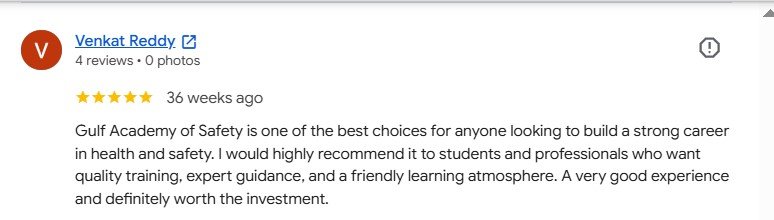
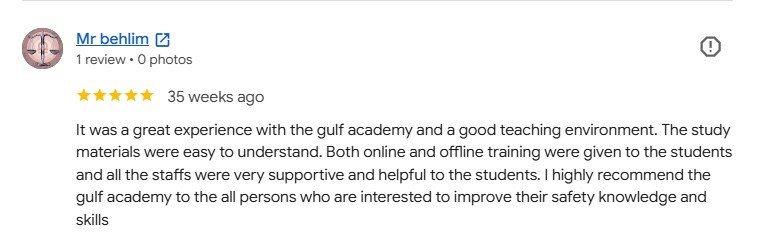
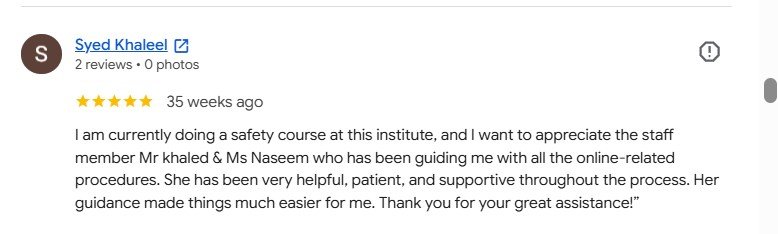

Contact Gulf Academy Safety to discuss your organization’s training requirements, employee roles, preferred delivery format, and HSE objectives.
NEBOSH IGC | IOSH | HSE Training | Workplace Safety Training
Protect your people. Strengthen your safety culture. Build a safer financial workplace.
Act now. Because in logistics, safety is the only destination.