
Farming is one of the hardest jobs, but it also keeps economies, communities, and businesses going. Farmers deal with a variety of workplace risks on a daily basis, from tractors and heavy machinery to pesticides, livestock, heat, physical handling, and long work hours. An injury, disease, damage to equipment, or expensive company interruption can result from one neglected risk.
For this reason, agricultural safety and health is more than merely a necessity for compliance. It is a useful strategy for enhancing productivity, safeguarding people, and establishing safer agricultural workplaces.
Through industry-relevant training, Gulf Academy Safety assists professionals, managers, employers, and employees in gaining the information necessary to recognize hazards, manage risks, and enhance workplace safety. Professionals can employ our learning pathways, such as ISEP, OSHA, and NEBOSH IGC, to enhance their knowledge of health and safety in agricultural and other high-risk work areas.
Physical, chemical, biological, mechanical, and environmental risks are all part of farming. In contrast to many traditional workplaces, agricultural workers frequently operate in shifting outdoor circumstances and may be exposed to several risks at once.
Organizations can transition from responding to accidents to preventing them with the use of good agricultural safety and health practices.
An agricultural workplace that is safer might reduce:
Workplace injuries and occupational illnesses
Accidents involving machinery
Exposure to chemicals
Falls, stumbles, and slips
Dehydration and heat stress
Unsafe manual handling
Injuries related to livestock
Electrical and fire incidents
Operational and environmental hazards
Slowing down farm operations is not the goal of safety. It is about ensuring that individuals can perform effectively without needless exposure to avoidable risks.
Understanding the risks associated with routine farming operations is the first step toward effective health and safety in agriculture. Even though a farm may appear serene and familiar, there are significant threats there that are simple to ignore.
Tractors, harvesters, loaders, pumps, irrigation systems, cutting equipment, and other machinery can be operated by workers. Additionally, they might deal with fuels, pesticides, fertilizers, cleaning agents, animal feces, and other dangerous materials.
An additional element of risk is created by the weather. Workers’ health and capacity to operate safely can be impacted by extreme heat, intense sunlight, rain, dust, humidity, and poor visibility.
Therefore, more than just basic safety guidelines are needed for strong health and safety in agricultural systems. Practical protocols, appropriate training, risk assessments, emergency plans, personal protective equipment, and efficient supervision are all necessary for employers.
Determine what might be harmful, comprehend who might be impacted, and implement efficient controls before an occurrence happens.
The goal of occupational health and safety in agriculture is to shield employees from both short-term injuries and long-term health issues related to their jobs.
Repeated lifting, uncomfortable postures, extended standing, vibration from machines, loud noises, dust inhalation, chemical exposure, and contact with biological risks are all possible aspects of agricultural employment. These exposures may eventually lead to fatigue, skin irritation, respiratory problems, musculoskeletal disorders, hearing loss, and other occupational health hazards.
Therefore, a robust approach to occupational health and safety in agriculture should consider both safety and health.
One of the main causes of severe agricultural injuries is machinery. Safe operating procedures should be understood by operators, and they should acquire the necessary training. When appropriate, lockout measures, maintenance controls, emergency stops, and guards should be employed.
Chemicals such as fuels, fertilizers, pesticides, and herbicides must be handled carefully. Labels, storage needs, exposure controls, spill protocols, and the proper PPE should all be understood by employees.
The body can be severely strained when lifting sacks, tools, feed, containers, equipment, and other items. Appropriate mechanical assistance and good manual handling techniques can lessen needless physical strain.
High amounts of vibration and noise can be produced by farm machinery. Long-term health concerns can be decreased with the use of appropriate exposure restrictions and hearing protection.
Outdoor agricultural workers may spend long periods under direct sunlight or in high temperatures. Hydration, rest breaks, suitable clothing, shade, and heat-awareness procedures can help protect workers.
Every workplace, including farms, needs efficient risk management. Instead of being viewed as an extra duty, health and safety on farms should be integrated into routine activities.
What might go wrong?
Who might be in danger?
How dire might the repercussions be?
What safeguards are in place already?
What other safeguards are necessary?
Employers can detect risks before they cause harm or interfere with operations by conducting routine risk assessments.
Health and safety on farms also depends on communication. Employees should be aware of the risks they face, the controls that must be in place, how to operate equipment, and what to do in an emergency.
When employees feel free to report risks, near-misses, dangerous situations, and equipment issues without worrying about being held accountable, a strong safety culture is established.
Agricultural workplaces can present many different hazards. Some of the most common include:
Risks of crush, collision, entanglement, and rollover can be created by tractors, harvesters, forklifts, trailers, and other mobile equipment.
Inhalation, skin contact, contamination, or environmental damage may arise from improper handling or storage.
Unpredictable animal behavior puts people at risk for falls, bites, kicks, and crushes
Serious fall dangers can be introduced by silos, storage spaces, roofs, ladders, and raised platforms.
Workers may be exposed to hazardous gases, oxygen shortages, or engulfment risks in tanks, silos, pits, and enclosed agricultural buildings.
Heat sources, equipment, electrical systems, fuel storage, and combustible items can all raise the risk of a fire.
Risks to one's health at work can be caused by polluted materials, bacteria, fungi, parasites, and animal excrement.
The first step is to recognize these risks. Effective control of them is the next phase.
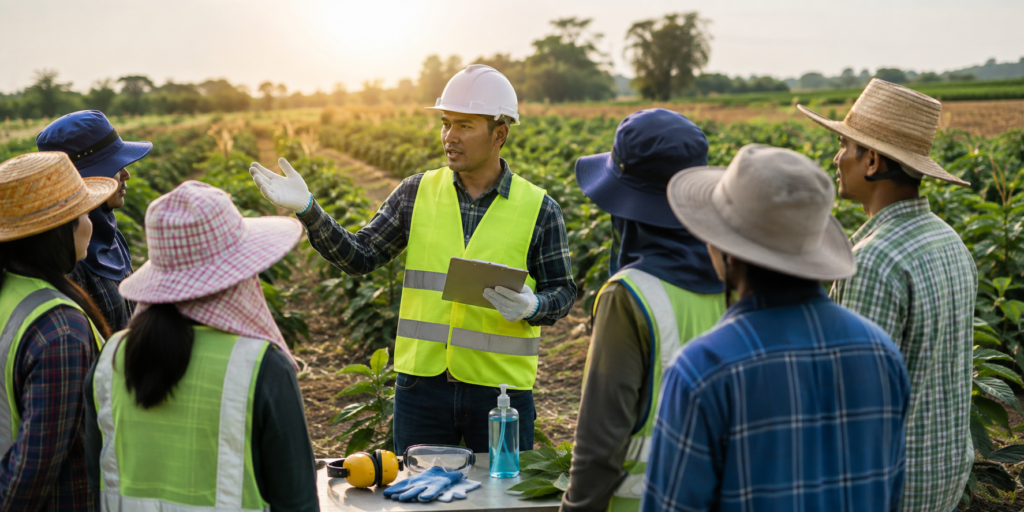
Effective farm safety training should be practical, relevant, and focused on real workplace situations. Employees require more than just theory. They must comprehend how safety precepts relate to the daily duties they carry out.
Determine the risks at work
Perform fundamental risk evaluations
Choose appropriate control measures.
Make proper use of PPE
Observe safe operating methods.
Address emergencies
Report events and close calls.
Enhance the culture of workplace safety
Managers and supervisors who are in charge of enforcing safety protocols and keeping an eye on employee performance can also benefit from appropriate farm safety training.
Professional training programs are offered by Gulf Academy Safety with the goal of fostering the development of useful information in the areas of health, safety, the environment, and risk management.
Preventing accidents is only one aspect of effective agricultural safety. Additionally, it promotes long-term operational performance, worker confidence, business continuity, and regulatory understanding.
Employees are more likely to continuously adhere to safety procedures when they comprehend their importance.
By establishing clear protocols, providing frequent training, carrying out inspections, looking into accidents, revising risk assessments, and promoting continuous improvement, employers may improve agricultural safety.
Leaders in safety should also consider risks that are not immediately apparent. If the underlying cause is disregarded, a modest near-miss today could turn into a major incident tomorrow.
Proactive safety management is important because of this.
Farmers and other agricultural workers may have several responsibilities in one day. They might handle chemicals, move supplies, run machinery, maintain equipment, work with animals, and oversee outdoor activities.
Because of this, farmers’ health and safety are especially crucial.
By anticipating high-risk tasks, maintaining equipment, eliminating pointless shortcuts, utilizing the required PPE, being aware of chemical risks, and making sure employees are appropriately taught, farmers can improve workplace safety.
Emergency preparedness is another crucial aspect of farmers’ health and safety. Fires, chemical spills, machinery mishaps, medical crises, extreme weather, and other predictable disasters should all be handled by farms with well-defined protocols.
The difference between a controlled emergency and a serious incident can be determined by preparation.
Agricultural organisations need professionals who can do more than recognise hazards. They need people who can assess risks, recommend effective controls, support management decisions, and help create a positive safety culture.
Gulf Academy Safety offers recognised learning pathways that can help professionals build these capabilities.
ISEP training can help learners develop knowledge in environmental and sustainability practices alongside broader workplace responsibilities. For professionals working within agriculture, environmental awareness can be particularly valuable because farming activities are closely connected with land, water, waste, resources, and sustainable operations.
OSHA-based training can help learners understand important workplace safety principles, hazard recognition, risk control, and safe working practices. This knowledge can support professionals working across agriculture, construction, industrial operations, and other sectors where effective hazard management is essential.
The NEBOSH IGC is a widely recognised health and safety qualification that can help learners develop a stronger understanding of workplace risk management, hazard control, and safety management principles. For agricultural professionals looking to progress into health and safety responsibilities, the NEBOSH IGC can provide a valuable foundation for developing structured safety-management knowledge.
Choosing the right training provider can make a major difference to your learning experience and professional development.
At Gulf Academy Safety, our focus is on helping learners gain practical knowledge they can apply in real workplace environments.
Our training approach supports professionals who want to:
Understand workplace hazards and effective control strategies.
Build qualifications that support professional growth in health and safety.
Learn how to influence safety culture and improve workplace performance.
Understand the principles that underpin effective workplace safety management.
Apply what you learn to real operational challenges.


Agriculture will always involve risk. The objective is not to remove every risk from farming. The objective is to understand the risks and control them intelligently.
A tractor should not become dangerous because someone failed to inspect it. A chemical should not cause exposure because workers were never trained. A heat-related illness should not happen because basic precautions were ignored.
Strong Agricultural Safety and Health systems are built through knowledge, planning, leadership, training, and continuous improvement.
Whether you are a farmer, agricultural worker, supervisor, HSE professional, manager, or organisation looking to strengthen workplace safety, investing in professional training can help you take the next step.




The agricultural sector needs skilled professionals who understand how to protect people while supporting efficient and sustainable operations.
Creating a safer agricultural workplace starts with the right knowledge and practical safety practices. Effective HSE training helps farmers and agricultural workers identify risks, prevent accidents, protect their health, and build a stronger culture of safety across every part of the farm.
Gulf Academy Safety provides ISEP, OSHA, and NEBOSH IGC training to help learners build valuable health, safety, environmental, and risk-management skills.
Do not wait for an incident to expose a weakness in your safety system. Train today. Strengthen your skills. Protect your people. Build a safer agricultural workplace with Gulf Academy Safety..
Enrol with Gulf Academy Safety and take the next step toward a stronger career and safer workplace