
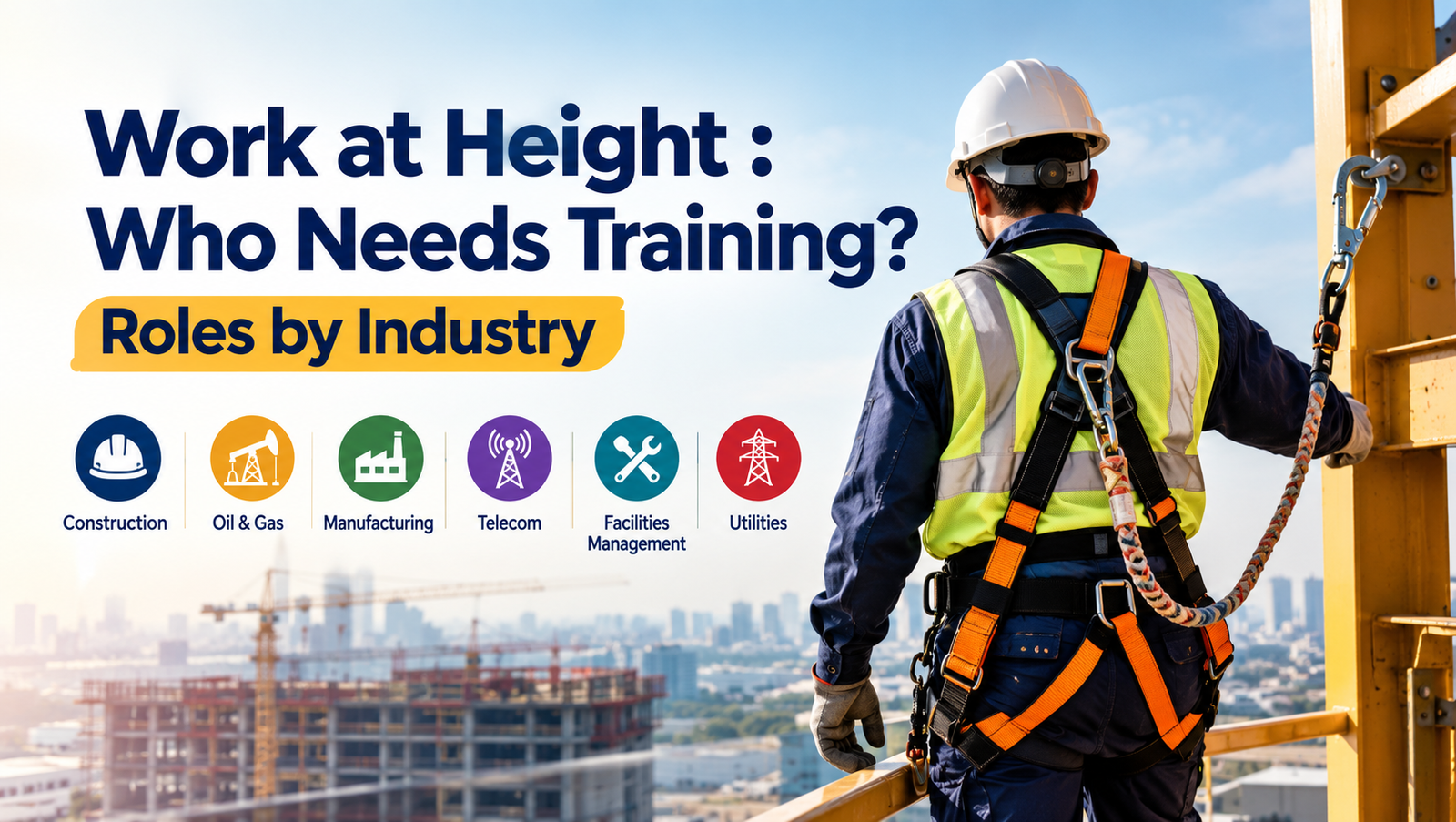
One of the biggest causes of death and severe industrial injuries in the Gulf and around the world is still working at height. The OSHAD System Framework specifically requires that “those involved in work at height are trained and competent” before starting any task in Abu Dhabi. However, both companies and employees often ask, “Does this apply to me, and if so, what level of training do I actually need?”
The simple answer is that height safety training is necessary for anyone who could fall a distance that could cause physical harm, no matter how short the task.
The lengthier response is contingent upon your industry, function, and particular equipment. To match the right certificate to the right person, this guide breaks down who needs working at-heights training by job function and industry.
The Baseline: Who Is Legally Required to Be Trained?
It is helpful to comprehend the general trigger before differentiating between jobs. Regulation 5 of the UK’s Work at Height Regulations, which are frequently used as a standard in Gulf training, stipulates that all individuals engaged in working at heights must be competent, which means they must have the necessary abilities, expertise, and experience.
This is further supported by the ADOSH-SF in Abu Dhabi, which mandates that employers offer training on fall protection plans, equipment use, hazard identification, inspection standards, and emergency rescue procedures prior to assigning workers to duties that pose a risk of falling.
Importantly, “work at height” has a wider definition than most people realize. Even if the job is below ground level, it encompasses any area where a person could fall from an edge, through an opening (such as a skylight), or even into a tank or trench.
A technician near an open floor perforation, a worker on a loading dock, or a maintenance worker on a delicate roof are all included in the scope.
The general guideline is that a person should not undertake a height task if they are unable to show that they are competent at it.
Roles by Industry: Who Needs Work at Height
Construction and Scaffolding
The industry with the highest concentration of height-related risk is still construction. Different training pathways are needed for different professions in this business.
Workers in general construction:
A fundamental Working at Heights certificate is necessary for anyone who occasionally works on ladders, mezzanine floors, or elevated platforms. This includes identifying hazards, understanding the principles of fall protection, and using personal fall arrest devices correctly. Instruction on safe ladder setup and use may be sufficient for low-risk, short-duration ladder tasks (less than 30 minutes), as long as it is documented and the worker is supervised if they lack experience.
Scaffolders
confront a much stricter requirement. Scaffolding work is not a general height task; rather, it calls for specialized, approved training that is in line with recognized programs like the UK’s CISRS (Construction Industry Scaffolders Record Scheme) or other national regulations. Only trained individuals under competent supervision are permitted to create, modify, and disassemble scaffolds; scaffolds from which a person could fall more than a predetermined threshold—for instance, five meters in New Zealand—need to be directly supervised by a certificate holder.
Each jurisdiction has a different scaffolding height at which extra regulations take effect, but the general idea is the same: the more formal the competence requirement, the higher the structure and the harsher the consequences of failure.
Fragile surface-specific training is necessary for roofing contractors. One common category of fatalities is falls through skylights and brittle roof materials. Pre-access roof condition evaluation, the use of crawl boards or staging, and the limitations of personal fall protection on surfaces that could suddenly collapse must all be included in training.
Oil, Gas, and Energy
Height hazards in the energy business are frequently compound in nature, involving height in conjunction with electrical risk, tight areas, or distant locations.
Wind Turbine Specialists:
They require height training in accordance with Global Wind Organization (GWO) guidelines, which cover manual handling, working at heights, and rescue from height modules. In the majority of markets, site access is non-negotiable.
Tower Climbers in Telecommunications:
Demand advanced training in rescue and fall protection. Transferring between structures, operating tools at heights, and climbing fixed ladders all require specialized skills that go beyond a general certificate. For complicated tower work, many employers demand IRATA (rope access) certification or its equivalent.
Workers performing maintenance at petrochemical and refinery facilities:
Frequently operate on vessel platforms, tall pipe racks, and columns. Since height work in process areas usually requires a PTW confirming risk assessment completion, equipment inspection, and rescue procedures, their training must incorporate permit-to-work integration.
Facilities Management and General Industry
Roofs are regularly accessed by maintenance workers in commercial buildings, hospitals, and industrial sites for equipment inspection, gutter cleaning, and HVAC service. If these workers utilize scissor lifts or boom lifts, they must receive training on mobile elevating work platforms (MEWPs); if they assemble temporary platforms, they must receive training on mobile access towers (like PASMA).
Logistics and Warehouse Employees are occasionally neglected:
Workers may be at risk for falls when performing tasks including loading dock operations, racking maintenance, and mezzanine picking. A brief ladder or platform safety induction is frequently suitable, but it needs to be documented and updated whenever tasks or equipment change.
Supervisors of Cleaning:
Understanding the hierarchy of control is necessary to manage window cleaning or high-level dusting; in particular, ladders should be used for access rather than as working platforms for lengthy activities. When to escalate to a MEWP or rope access solution should be emphasized in their training.
Emergency Services and Specialist Rescue
Training that extends beyond prevention is necessary for firefighters, rescue workers, and industrial rescue teams. Rescue from a height is a unique skill. ADOSH-SF mandates that training include hands-on rescue exercises and that emergency response protocols for work at heights be established before work begins. Employers must have a site-specific rescue capability; relying on outside emergency agencies for rescue is inadequate preparation.
What About Supervisors and Managers?
At the supervisory level, there is a typical compliance gap. No one should organize, plan, or oversee work at height unless they are competent or under the supervision of a competent person, according to the ADOSH-SF. This implies that a site supervisor is liable if they approve a height permit without being aware of the constraints on fall safety.
Supervisors must get training on height safety awareness that includes:
- How to interpret and validate a risk assessment for working at heights
- How to confront insufficient controls and the hierarchy of control (avoid, prevent, minimize)
- Verification of equipment inspections (not necessarily performing inspections, but verifying their completion)
- Review of the emergency rescue plan
- Authorization requirements for work permits
This is not the same as operator training. It is not necessary for a supervisor to know how to rig a fall arrest device, but they must be able to tell when someone has done it wrong.
The Working at Heights Certificate: What It Should Contain
Not every certificate is created equal. Make sure the following topics are included when assessing training providers or creating internal programs, in accordance with ADOSH-SF and HSE guidelines:
| Module | Why It Matters |
| Fall hazard identification | Includes fragile surfaces, openings, edges, and dropped object risk |
| Hierarchy of control | Avoid → Prevent → Minimise; collective protection before personal protection |
| Equipment selection and inspection | Harnesses, lanyards, anchor points, MEWPs, ladders—pre-use checks and limitations |
| Practical equipment use | Donning/doffing harness, connecting to anchors, system compatibility |
| Rescue and suspension trauma | Recognising suspension trauma and executing or summoning rescue |
| Risk assessment integration | How the site-specific risk assessment translates into the task at hand |
Certificate validity varies. Most certificates last 2–3 years, but refresher training is needed if equipment or job duties change or skills decline. High-risk roles, such as rescue and rope access, require annual refresher training.
Risk Assessment: The Gatekeeper for Training Decisions
The working at height risk assessment is not merely paperwork—it is the tool that determines who needs what training. A robust assessment answers three questions:
- Is it possible to complete the task from the ground? If so, that task doesn’t require height training.
- What happens if someone falls? Even a two-meter fall might result in death or severe disability. Low heights must not be trivialized in the evaluation.
- Which controls are necessary, and what level of skill are they requiring? Compared to a personal fall arrest device, a guardrail system requires less individual skill. Each role’s minimal training requirements should be specified in the evaluation.
The evaluation should be included in a method statement for difficult or high-risk work, which should include information about the equipment to be utilized, the work sequence, and the persons who have been verified to be competent.
Also Read: Safety Office Salary in Saudi Arabia: Complete KSA Market Breakdown
Conclusion: Training Is a Control, Not a Checkbox
At the end, the issue “who needs working at heights training?” boils down to a more straightforward idea: everyone whose job puts them at danger of falling must be able to show that they can safely handle that risk. The risk assessment should determine the particular certificate, not cost or convenience, whether it is a supervisor awareness course, a GWO module, a CISRS scaffolders ticket, or a fundamental Working at Heights card.
The regulatory path is evident for employers in the Gulf. Documented competence, site-specific training materials, and proof that training was given before exposure are required by ADOSH-SF and comparable frameworks around the region. A worker who can accurately check their harness, locate the anchor point, and describe the rescue plan complies; a certificate in a drawer is not.
Accredited working at heights training that complies with ADOSH-SF, HSE, and industry-specific standards is provided by Gulf Academy Safety. Get in touch with us to determine the best training path for your employees.
