

Every plate of food that reaches a customer carries an invisible responsibility — the responsibility of safety. From restaurants and hotels to food processing plants and catering companies, one lapse in hygiene can lead to outbreaks, reputational damage, and even loss of life. That is why food safety training has become one of the most sought-after professional qualifications across the Gulf region today. Whether you are a kitchen supervisor, a quality assurance manager, or an HSE professional looking to expand your skill set, structured food safety training equips you with the knowledge to prevent contamination, meet legal standards, and protect public health.
At Gulf Academy Safety, we understand that food businesses of every size need practical, industry-relevant training that goes beyond a certificate on the wall. A well-structured food safety course equips professionals and organisations with the knowledge and practical skills needed to manage food safety responsibilities effectively. We provide industry-focused training programs, including a globally recognised CPD-accredited pathway, designed to help individuals and teams build competence, achieve certification, and maintain workplace compliance.
Food safety incidents rarely result from one big mistake. More often, they stem from small, everyday oversights — an unwashed hand, an improperly stored ingredient, a cross-contaminated cutting board. A well-structured food safety course trains staff to recognise these risks before they become incidents.
Governments and regulatory bodies across the Gulf now require food handlers, supervisors, and managers to hold valid certification to legally work in food-related roles. Businesses that skip this step risk fines, closures, and — more importantly — the health of the people they serve. This is why demand for food and safety training has grown steadily across hotels, restaurants, catering companies, supermarkets, and food manufacturing units.
Not all training programs are created equal. A comprehensive food safety training course should include:
Personal hygiene, safe food handling, and cross-contamination prevention
Identifying and controlling hazards at critical points in the food chain
Correct handling of chilled, frozen, and hot food
For kitchens, equipment, and food-contact surfaces
Understanding local food safety laws and international standards
Identifying, labelling, and communicating allergen risks
At Gulf Academy Safety, our courses are designed by industry practitioners and cover each of these areas in depth, ensuring learners leave with skills they can apply on day one.
While every food handler benefits from basic hygiene training, some roles demand a more advanced qualification. A food safety officer course is built for individuals who will be responsible for auditing, monitoring, and enforcing food safety standards within an organisation. This includes:
Quality assurance and quality control staff in food manufacturing
Kitchen and restaurant supervisors
HSE officers working within food production or hospitality environments
Compliance and audit personnel in the food supply chain
A food safety officer is expected to do more than follow procedure — they need to design, implement, and monitor food safety management systems. Gulf Academy Safety’s food safety officer training gives learners the tools to conduct internal audits, lead HACCP implementation, and manage non-conformances effectively.


Food safety doesn’t exist in isolation — it is a core part of any organisation’s broader Health, Safety, and Environment strategy. HSE food safety training bridges the gap between general workplace safety and the specific hazards found in food-handling environments, such as chemical contamination, equipment-related injuries, and biological hazards from improperly stored produce.
For HSE professionals, adding food safety expertise to their skill set makes them significantly more valuable to employers in the hospitality, catering, and food manufacturing sectors — industries where safety officers must understand both workplace hazards and food-specific risks side by side.
A food hygiene certificate is often the first formal qualification anyone entering the food industry will need. It confirms that a learner understands the basics of safe food handling, storage, and hygiene practices required to prevent foodborne illness. Depending on the role and jurisdiction, this certificate may need to be renewed periodically to ensure knowledge stays current with evolving regulations and best practices.
Employers increasingly view the food hygiene certificate not as a one-time formality, but as an ongoing commitment to staff development and customer safety — and Gulf Academy Safety issues certification that is recognised and respected across the region.
Gulf Academy Safety offers a wide portfolio of globally recognised courses, including NEBOSH, IOSH, OSHA, CPD, ISEP, and NVQ. Among these, our CPD-accredited courses are the most directly aligned with food safety training. CPD (Continuing Professional Development) certification is specifically designed for skills-based, practice-oriented learning like food hygiene and food safety management — making it the ideal framework for professionals who need recognised, verifiable proof of competence without the extended duration of a full diploma programme.
That said, professionals aiming for broader HSE career growth alongside food safety expertise often pair their food safety certification with an IOSH or NEBOSH qualification, giving them a well-rounded profile that covers both occupational safety and food-specific hygiene management. For those in supervisory or technical food production roles, an NVQ pathway can also complement food safety training by validating on-the-job competence over time.
If your goal is focused, fast, and industry-recognised food safety certification, Gulf Academy Safety’s CPD-accredited food safety training is the right starting point.
Choosing the right training provider is a strategic decision. Here’s why we are the trusted choice for your HSE training in automotive needs:

Our courses meet international food safety and hygiene standards

Instructors with real-world food industry and HSE backgrounds

Classroom, on-site, and online options for individuals and teams

From foundational food hygiene certificates to advanced food safety officer training

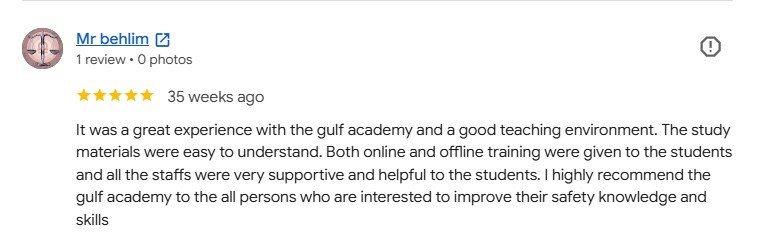


Food safety isn’t just a certificate — it’s a commitment to protecting the people who trust you with their meals. Whether you need a foundational food hygiene certificate, a specialised food safety officer course, or HSE food safety training for your wider team, Gulf Academy Safety has a programme built for you.
Contact Gulf Academy Safety today to enrol in our next food safety training batch, or speak with our course advisors to find the right qualification path — including our CPD-accredited food safety courses — for you or your team.
Act now. In the fast lane, safety is the only speed limit.