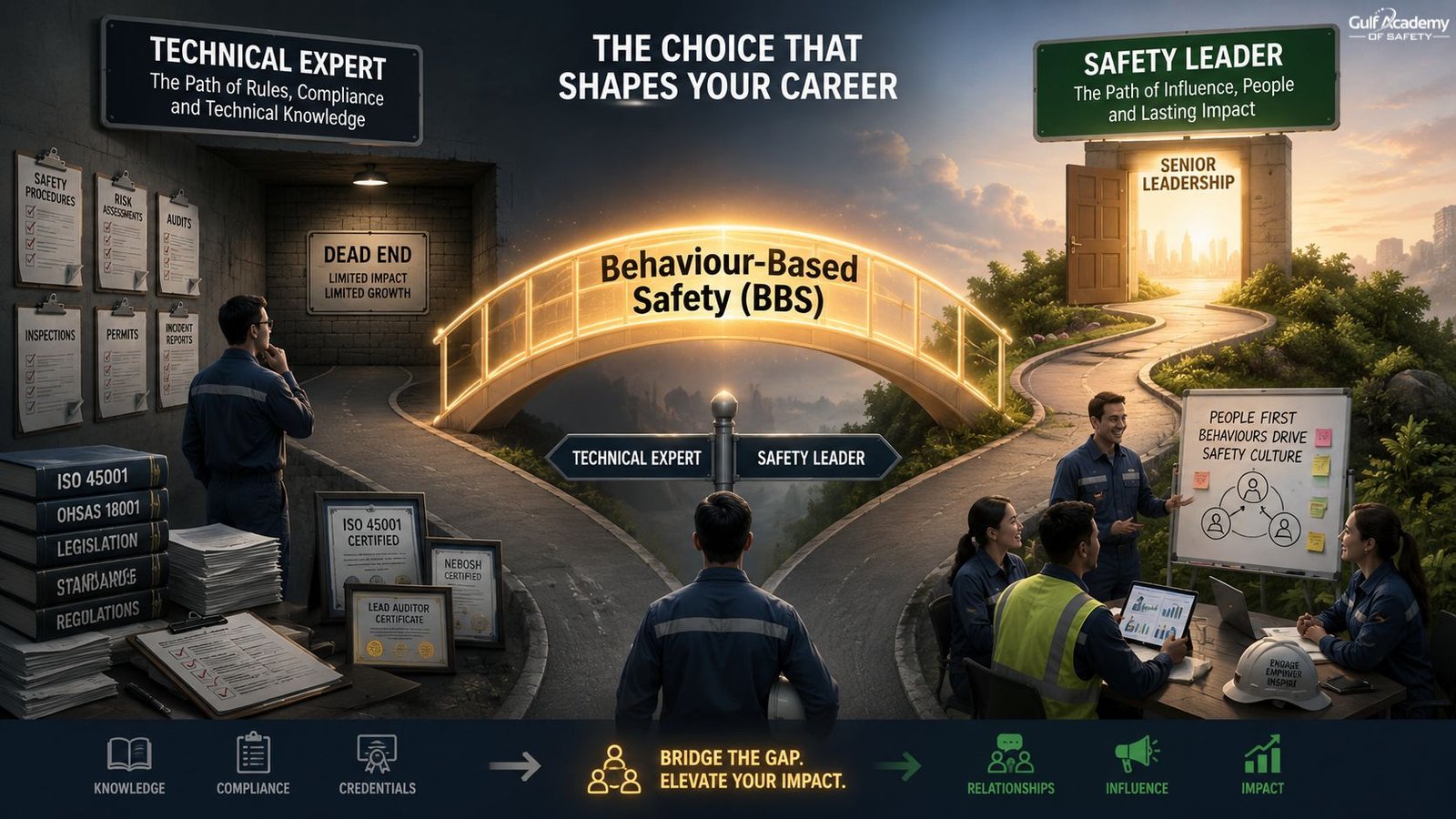
Every HSE department has a silent rift. On the one hand, technically proficient safety officers are able to reference ISO 45001 from memory, file incident reports on time, and have a thorough understanding of the standard. Conversely, those who receive promotions. Behaviour-Based Safety (BBS) and the variety of human abilities it requires are typically what make a difference. Another certification is probably not the answer if you’ve been wondering how to advance in your career as a safety officer. It involves knowing how to modify behaviour at scale.
What Behaviour-Based Safety (BBS) Actually Is
A data-driven strategy for preventing accidents, behaviour-based safety places greater emphasis on observable worker behaviour than on results, tools, or documentation. BBS practitioners observe how work actually occurs and take action before an issue occurs, rather than waiting for something to go wrong and looking into it after the fact.
Based on applied behavioural analysis, the model runs on a straightforward loop:
Observe → Measure → Reinforce → Repeat
Supervisors observe employees as they carry out their duties. They recognize and encourage safe behaviours. Instead of placing blame or taking disciplinary action, they use coaching conversations to address at-risk behaviours. Incident rates decrease as the proportion of safe-to-at-risk behaviours changes over time.
The outcomes speak for themselves. Organisations that adopt structured BBS programs regularly report significant reductions in recordable incident rates, often within the first year.. What the case studies don’t frequently emphasise, though, is that those outcomes are totally reliant on the program administrators’ interpersonal abilities.
Why BBS Is, at Its Core, a Soft Skill
This takes aback the majority of safety experts.
You can become certified and study every book on Behaviour-Based Safety BBS, but you won’t be able to make a difference since the system is only effective when employees have faith in those who are using it. Furthermore, trust is not a technical skill. It’s a human one.
For BBS to be effective, it needs:
.
Surveillance-free observation.
Employees must understand that observations are intended to teach them, not to expose them. A regulatory standard lacks empathy, clarity, and psychological safety, all of which are necessary for communicating that distinction.
coaching discussions rather than corrections.
Supervisors should not issue a written warning when they notice an at-risk behaviour. It’s a dialogue. “Walk me through why you approached it that way” is a fair question for a BBS observer. Before speaking, they listen. Before recommending a change, they acknowledge the context. Conflict-aware communication is a fundamental safety leadership competency.
Credibility on the ground.
A new poster or revised policy does not alter the safety culture in the company. When frontline employees feel that the individual speaking to them genuinely understands their job, things change. It is not authority but presence, consistency, and sincere inquiry that help BBS practitioners gain that credibility.
Data narrative.
If you cannot turn observation data into a story that inspires leadership to take action, the data is useless. The people who wind up in the decision-making room are safety officers who can effectively deliver BBS findings, linking behavioural trends to business risk rather than merely to incident statistics.
These are soft skills related to HSE. Additionally, these are not by accident the competencies that characterise senior safety leadership.
The Career Angle No One Talks About
The path to promotion as a safety officer is more precise than most career advice indicates, so let’s be honest about it.
Senior HSE roles — safety manager, HSE director, Head of EHS — share a consistent job description pattern. Technical compliance is listed as a baseline expectation, not a differentiator. What hiring panels and promotion committees actually evaluate is this:
- Can you have an impact on others who don’t work for you?
- Can you change culture instead of merely enforcing rules?
- In terms of leadership, are you able to present the business case for safety?
BBS training builds all three capabilities — and it builds them in ways that are apparent and measurable. You have trend lines, observation data, and recorded coaching talks when you operate a BBS program. Not only have you finished an audit, but you also have proof that your behavior has changed.
Your promotion case is that proof.
It is uncommon for safety inspectors to view workplace safety culture as a system to be developed rather than a checklist to be upheld. Businesses that have truly undergone cultural change are able to recognise the difference right away and adjust their compensation accordingly.
What Safety Leadership Skills BBS Actually Builds
Here’s a practical breakdown of the safety leadership skills that BBS develops, and why each one matters for career advancement:
Facilitation and influence:
Coaching discussions and BBS observation cards are systematic methods of influence without authority. Instead of instructing someone on what to do, you’re setting the stage for them to make safer decisions. Senior executives utilise the same power to influence change in areas they do not own.
Systemic thinking is Effective:
Instead of asking “who made the error?” BBS practitioners ask, “What conditions made this error likely?” That change in perspective is precisely how safety experts at the executive level think. Additionally, it’s how you gain the respect of leaders in operations, engineering, and human resources who are fed up with safety being viewed as a blame function.
Change management:
Stakeholder management, communication planning, and persistent follow-through are all essential change management skills for implementing BBS throughout a site or organisation. Functionally, safety officials who have spearheaded a BBS implementation have also spearheaded an organisational reform initiative. It is a transferable experience.
Coaching and development:
Frontline employees are trained to become peer observers through several BBS programs. You have overseen a people development program if you created and oversaw that training. When you include that in your career story, you become a capability builder rather than merely a safety officer.
Building a Safety Culture Workplace: BBS as the Foundation
The term “safety culture in the workplace” is frequently used interchangeably with “people follow the rules.” The degree to which safety is a shared value that influences behaviour when no one is around is what defines a true safety culture.
Because it operates at the level of daily behaviour rather than yearly training or top-down mandates, BBS is one of the most evidence-based approaches for creating that kind of culture.
There is a clear trend in the societal change that BBS promotes:
Phase 1:
Conformance. Because they are being watched, employees act in a safe manner. This is the beginning, not the end.
Phase 2:
Habit. Safe conduct becomes the norm. Selecting safety reduces the cognitive burden.
Phase 3:
Value. Employees start mentoring one another. Instead of being something that is done to employees, safety becomes something that they own.
It takes years, steady leadership, and precisely the kind of interpersonal abilities that BBS fosters to move an organisation from Phase 1 to Phase 3. At the highest levels, safety officers who can articulate that journey and their part in it have a compelling career narrative.
Common Mistakes That Stall BBS Programmes (and Careers)
A few patterns consistently derail both BBS initiatives and the careers of the people running them:
Turning BBS into surveillance:
Employee participation collapses, and trust is lost if they feel that observations are being utilised to construct disciplinary cases. Safety officials who commit this error are frequently left out of the cultural discussions that they should participate in.
Reporting data without a narrative:
For a CFO, observation percentages are meaningless. It receives attention when safe behaviour rates are linked to near-miss patterns, contractor incident expenses, or insurance premiums. Safety officers who solely discuss safety metrics have a tendency to get isolated from other safety functions.
Neglecting management behaviour:
A BBS that ignores supervisory behaviour and solely targets frontline employees is ineffective. When managers are not subject to inspection, employees become aware of it, and the program’s credibility declines. The most successful BBS practitioners apply the same perspective to leadership behaviours, which call for bravery in addition to skill.
Also Check: Boost Your Construction Career with OSHA 30 Certification
Implementing without securing psychological safety first:
In a blame culture, BBS generates defensive behaviour rather than truthful observation data. The program won’t succeed if the organisational setting isn’t prepared, and the safety officer’s reputation suffers. It is a senior-level talent in and of itself to evaluate preparedness and take proactive measures to address it.
Practical Steps to Start Building Your BBS Capability Now
You don’t need to wait for a formal programme to develop these skills:
Start observing deliberately:
Start spending time on the floor, seeing how work is actually done, even in the absence of a formal BBS procedure. Make notes. Seek out trends. This strengthens the presence and observation muscle needed for BBS.
Practice the coaching conversation:
When talking about safety, look for low-stakes situations where you can utilise open-ended questions instead of commands. Asking “what made you approach it that way?” causes you to see changes. Rather than asking “Why did you do that?”
Learn to tell a data story:
Practice presenting your current safety statistics to a non-safety audience, such as an operations peer or a finance contact. What do they react to? What makes them feel chilly? This feedback is really helpful.
Get formal exposure:
BBS methodology is used in several university-level HSE leadership courses, the IOSH Managing Safely program, and the Cambridge BBS certification. One planned training session will provide you with frameworks that you can use right away.
Make your soft skills visible:
Make sure to specifically mention the leadership abilities you used in projects, performance evaluations, and professional development plans, rather than just the compliance results you attained. Coaching, influence, and facilitation. These must be documented.
The Promotion Equation
Here’s the most straightforward explanation of how to advance your career in HSE if you’re serious about it:
Technical expertise opens doors for you. Having a certification helps you stay competitive. However, what advances you is your capacity to alter people’s attitudes and actions and to show that you’ve done so on a large scale.
One of the few frameworks in the HSE field that specifically develops and assesses that skill is Behaviour-Based Safety (BBS). Behaviour-Based Safety (BBS) provides you with a practical methodology supported by meaningful data and actionable insights. It helps you interpret observation data and turn it into compelling information that drives informed decision-making. At the same time, it develops leadership skills in safety that are valuable at every level of an organisation. Most importantly, it shows you how to build a strong workplace safety culture that CEOs often highlight in strategic plans, but many organisations struggle to implement effectively.
Additionally, it accomplishes all of this in a form that is observable, quantifiable, and marketable.
The safety officers with the biggest array of certificates are not now the ones getting promoted the quickest. They are the ones who entered a website, gained unearned trust, and changed people’s behaviour when no one was around.
Behaviour Based Safety is that. And it’s precisely the next skill your career needs.
Read more: Safety Officer Salary in Saudi Arabia Complete KSA Marketdown 2026