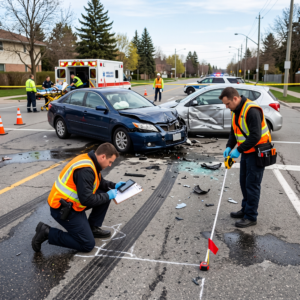
Accidents don’t occur in a vacuum. Nearly all workplace incidents are the result of a series of tiny mistakes, such as a neglected inspection, an overlooked near-miss, or a shortcut that no one reported. The goal of Gulf Academy Safety’s CPD Accident Investigation and Reporting course is to identify that chain and prevent it from happening again.
Filling out forms when anything goes wrong is not the focus of this training. It’s about developing the investigation skills necessary to identify the true reason of an incident, not just the apparent one, and producing a report that genuinely brings about change.
Why Accident Investigation Skills Matter Right Now
Every company has a template for an incident report. There are very few people who actually know how to operate one correctly. Because of this gap, accident investigation has emerged as one of the most sought-after competencies among HSE teams in the United Arab Emirates, Saudi Arabia, and the larger Gulf area.
Nothing changes when a poorly investigated incident is closed with an ambiguous result (such as “employee error”). When a failure is adequately investigated, it may be traced back through equipment, procedure, supervision, and culture until the true root cause is found. This distinction is what divides an accident-prone workplace from one that actually learns from it.
What You'll Learn in the CPD Accident Investigation and Reporting Course
This training was developed by Gulf Academy Safety based on the real-world experience of thoroughly examining a workplace event. You will cover:
The purpose and legal basis for investigating incidents
Why organizations are obligated to investigate, and what regulators expect to see
Immediate response and scene management
Securing evidence, first aid documentation, and preserving the incident site before details are lost
Root cause analysis techniques
including the 5 Whys method and Fishbone (Ishikawa) analysis, to move past surface-level explanations
Witness interview techniques
How to gather accurate, unbiased accounts without leading the conversation
Report writing skills — structuring findings clearly enough that management, regulators, and insurers can act on them immediately
Corrective and preventive action planning
So every investigation ends with a real plan to stop recurrence, not just a filed document
By the end of the story, you are capable of investigating the initial phone call to the final signed-off report, in addition to being knowledgeable about incident investigation and reporting theory.
Where This Fits Into Broader Incident Management
An investigation is but one component of a larger system. Effective incident management relies on an organization’s ability to recognize, look into, document, and respond to all incidents, not just the major ones. This course places accident inquiry in the context of that broader cycle, whereby near-misses contribute to it, corrective actions result from it, and safety culture develops as a result.
After completing this course, professionals frequently find themselves taking ownership of the full cycle inside their company, not just responding to problems but also enhancing overall incident management.
Training Methods
E - Learning
Who Should Take This Course
This CPD course on accident investigation and reporting is designed for a variety of professionals, such as:
HSE Officers and Coordinators who presently conduct incident investigations without receiving formal training in the methodology
After an event, site supervisors and line managers are frequently the first on the scene.
Safety consultants and advisors who wish to bolster their resumes with a globally recognized credential
Anyone in charge of composing or examining incident reports for their company
Enrollment does not require any prior formal qualifications.
A sincere interest in determining the true cause of workplace mishaps is more important than merely recording their occurrence.
How the Course Is Assessed
This course is offered as a flexible, self-paced online course, similar to Gulf Academy Safety’s other CPD programs. It is evaluated by an open-book online multiple-choice question test, with unlimited attempts if necessary. The emphasis remains on truly digesting the subject rather than memorization under time pressure; there is no pressure of a single high-stakes exam sitting.
What You Receive as a CPD Certified Incident Investigation Professional
Upon successful completion, you are awarded a CPD certificate that is widely accepted in the manufacturing, construction, oil & gas, healthcare, and facilities management industries. It lets companies know that you are capable of conducting a thorough investigation on your own and that you are CPD Certified Incident Investigation competent, in addition to being knowledgeable of safety protocols.
Additionally, each course includes up to 15 CPD credits, which directly contribute to your ongoing requirements for continuing professional development. This is an important aspect if you’re pursuing or maintaining membership in a professional organization like IOSH.
This course was created by Gulf Academy Safety in collaboration with working HSE specialists rather than only instructional designers; thus, each lesson represents real-world workplace investigations rather than merely theoretical concepts from textbooks. Instead of scheduling certain classroom days, you can study around your current work obligations because the course is entirely online and self-paced.
Employers and government organizations throughout Saudi Arabia and the United Arab Emirates accept CPD certificates from Gulf Academy Safety, giving this credential real, useful weight wherever you are located in the Gulf.
Are you prepared to develop actual accident investigation skills? Enroll in Gulf Academy Safety’s CPD Accident Investigation and Reporting course right now.
The CPD Accident Investigation and Reporting course is assessed through an open-book online MCQ exam, with unlimited attempts available if needed.
Do I need prior HSE experience to enroll?
No formal prerequisite is required. The course is accessible to both newcomers handling their first investigation and experienced professionals formalizing existing skills.
How long does the course take to complete?
It’s fully self-paced, so timing depends on your availability — most learners complete it within a few weeks of part-time study.
Is the certificate recognized outside the Gulf region?
Yes. CPD certification is internationally recognized, and Gulf Academy Safety’s certificates are specifically accepted by employers and government entities across the UAE and Saudi Arabia.
What's the difference between this course and a general risk assessment course?
Risk assessment focuses on preventing incidents before they happen. This course focuses on what to do after one occurs — investigating it properly and preventing recurrence through structured incident investigation and reporting.