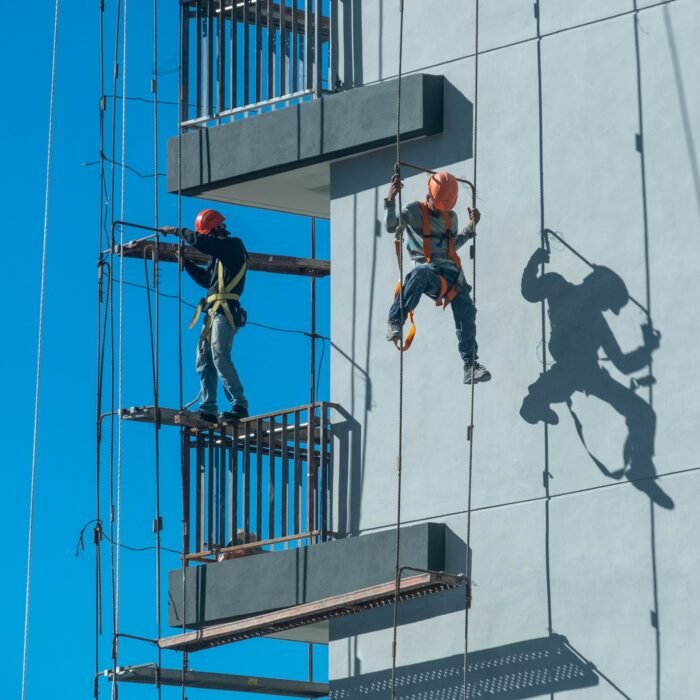
In the construction, maintenance, logistics, and industrial sectors globally, falls from heights continue to be one of the main causes of serious occupational injuries and fatalities. A harness check was neglected. An exposed edge. A ladder placed on an uneven surface. Until they become dramatic, none of these appear dramatic. Working at height safety isn’t a box-ticking exercise because of this. It’s among the most important skill sets a safety worker can have.
إن CPD Working at Height course from Gulf Academy Safety was designed to bridge the knowledge gap between the existence of regulations and their practical application on a real site, with real consequences if something goes wrong.
Why Working at Height Safety Deserves Serious Attention
If you ask any seasoned HSE specialist which category of hazards results in the greatest number of fatalities on a normal industrial or construction site, height-related incidents will nearly always come in first. Because scaffolding, rooftops, elevated platforms, and ladders are commonplace on most sites, familiarity fosters shortcuts, which makes it especially risky.
It doesn’t take a dramatic setting for working at heights to become lethal. When fundamental controls were disregarded, routine maintenance tasks, warehouse racking, and even basic window cleaning have all led to catastrophic falls. Strong working at height safety practices focus on ensuring that every task at elevation is planned, regulated, and carried out with the appropriate tools and mentality rather than avoiding height work, which is rarely possible.
What the CPD Working at Height Course Covers
This course covers more than just the equipment checklist; it covers the entire lifecycle of securely handling elevated work. You’ll discover:
The hierarchy of controls for work and height risk
When to completely avoid height work, when to employ guardrails or other collective protection, and when personal fall protection is required
Fall prevention vs. fall arrest systems
Understanding the critical difference and when each applies
Equipment inspection and maintenance
Harnesses, lanyards, anchor points, scaffolding, and mobile elevated work platforms (MEWPs)
Rescue planning
Because a fall arrest system that stops a fall still requires a rescue plan; suspension trauma is a real and serious risk
Legal duties and regulatory requirements
Around working at height, including employer and worker responsibilities
Common failure points
The specific, recurring mistakes that lead to real incidents, drawn from actual case studies
You won’t just be able to spot hazards when you encounter them by the conclusion of the course. You’ll know exactly how to manage it, record it, and share it with a larger team.
Working at Heights: A Risk That Spans Every Industry
It’s simple to think of height work only in terms of building, but that’s a limited perspective. Warehousing, oil and gas, telecommunications, facilities management, aviation, and even retail are industries where working at heights is common. Regardless of the industry name, the same basic risks are present every time someone accesses a rooftop, climbs a ladder, or works from a platform.
This course is designed to be a truly cross-sector qualification because of this. Regardless of the site you are working on, the fundamental concepts of risk assessment, equipment use, and fall prevention apply.
Training Methods
E - Learning
Who Should Take This Course
The purpose of the CPD Working at Height course is to:
Safety officers and site supervisors in charge of elevated work activities
Teams in charge of maintenance and facilities who frequently visit racking, platforms, or rooftops
Construction workers overseeing scaffolding, ladders, or MEWPs on the job site; HSE workers seeking to enhance their resume with a globally recognized, specialized credential
Although there is no official prerequisite to enroll, you will benefit most from the course material if you have a general understanding of workplace safety principles.
Earning Your Working at Heights Certificate
Gulf Academy Safety’s CPD program will grant you a working at heights certificate upon successful completion. This credential is accepted by Saudi Arabian and UAE businesses and government agencies. This course, like our other CPD courses, is offered as a flexible, self-paced online program and is evaluated using an open-book multiple-choice question test (MCQ) with unlimited attempts if necessary. This keeps the emphasis on true comprehension rather than exam-day stress.
Additionally, each course offers up to 15 CPD credits, which enhance your continuous professional development record. This is helpful whether you’re trying to keep your membership in a professional organization or are just trying to strengthen and improve your safety resume.
Instead of being developed only from a regulation textbook, this course was created by safety experts with firsthand experience controlling height-related risk in construction, industrial, and facilities settings. The case studies, the equipment instructions, and the actual failure points it guides you through all demonstrate this practical foundation.
You can finish the CPD Working at Height course around your current work schedule without missing scheduled class days if you study totally online. Additionally, the certificate has real, useful value wherever your career in the Gulf leads you because it is widely recognized in Saudi Arabia and the United Arab Emirates.
Are you prepared to develop true proficiency in working at heights? Enroll in Gulf Academy Safety’s CPD Working at Height course right now.
Is this course suitable for beginners with no prior safety training?
Yes. While general safety awareness helps, no formal prerequisite qualification is required to enroll in this working at height safety course.
How is the course assessed?
Through an open-book online MCQ exam, with unlimited attempts available if needed — there’s no single high-pressure exam sitting.
How long does it take to complete?
The course is fully self-paced. Most learners complete it within a few weeks of part-time study, depending on availability.
Is the working at heights certificate recognized outside the Gulf?
CPD certification carries international recognition, and Gulf Academy Safety’s certificates are specifically accepted by employers and government entities across the UAE and Saudi Arabia.
Does this course cover scaffolding and MEWP-specific training?
It covers the core safety principles around scaffolding, ladders, and mobile elevated work platforms as part of a broader working at height safety framework, rather than equipment-specific operator certification.